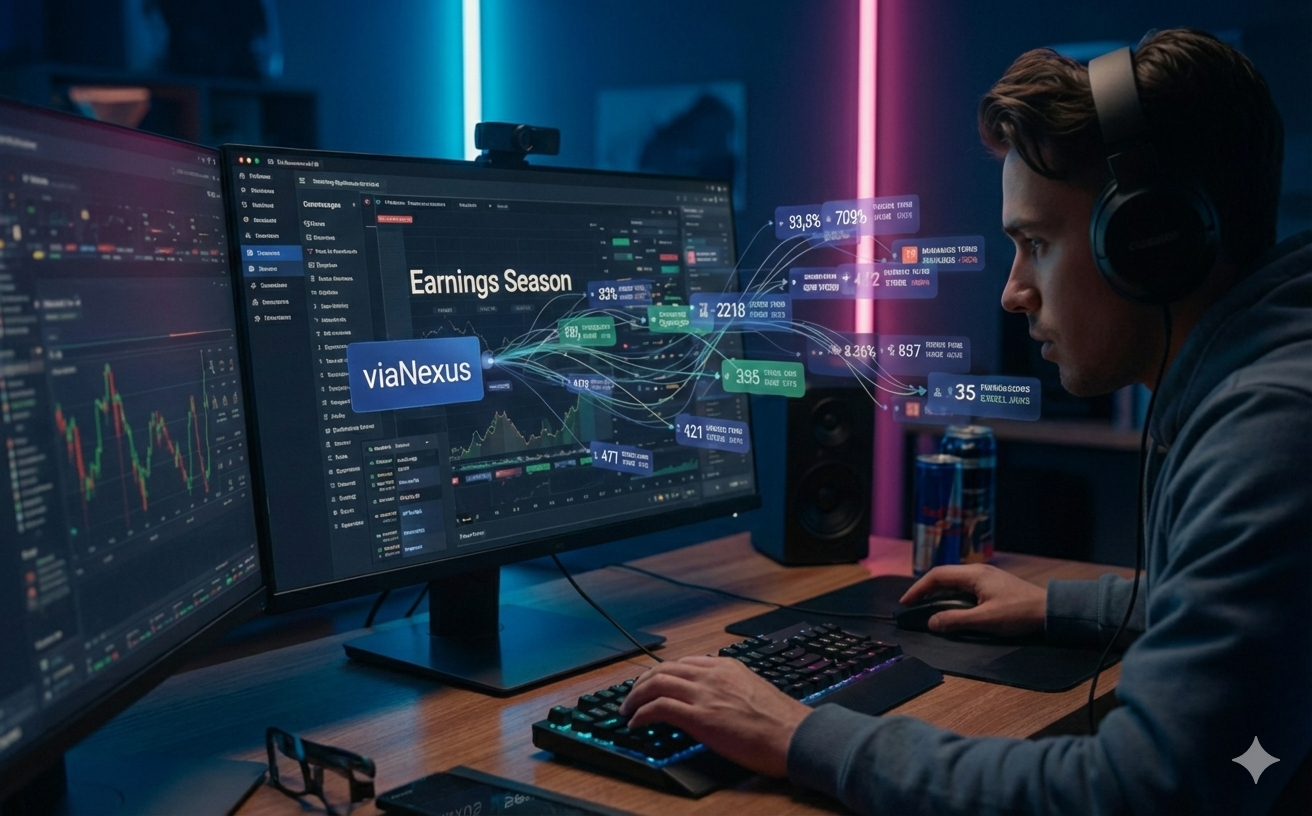
Earnings season is when the market shows its hand. Four times a year, thousands of companies report their numbers, host their calls, and set expectations for the quarter ahead. For investors, analysts, and traders, it's information overload. For the developers building the tools they rely on, it's a data integration nightmare. And with all this chaos comes risk—miss a consensus shift, miss a call date, miss why the stock moved.
Think about what goes into a useful earnings application. Your users need to know when calls are happening—not just the date, but the actual time, the dial-in details, the webcast URL. They need context:
What did the company report last quarter? What's the consensus this time? What's the news sentiment heading into the call? And how on earth do they monitor multiple calls simultaneously, maybe even get real-time transcripts as executives speak.
Building that used to mean stitching together data from half a dozen sources. You'd pull filings from EDGAR for confirmed dates. You'd integrate an estimates provider for consensus numbers. You'd add a news feed for sentiment. You'd find a transcript vendor for call content. Each source has its own schema, its own update cadence, its own quirks. By the time you've normalized everything and built the integrations, earnings season is half over.
The Old Model Is Breaking Down
The traditional approach—pick a primary vendor, supplement with a few feeds, build your own normalization layer— that kind of worked when data moved slower and applications were simpler. But the pace has changed. AI-driven workflows need clean, structured data they can reason over. Modern applications need to react in real time. Portfolio managers want to track thirty earnings calls at once, switching between live transcripts and historical performance. The data infrastructure that powered Bloomberg terminals in 2015 isn't built for the applications people are building in 2026.
What's needed is a different model entirely: pre-normalized data from multiple authoritative sources, accessible through a single API layer, designed from the ground up to support the way developers actually build.
How viaNexus Approaches Earnings Data
viaNexus treats earnings season as what it is: a mosaic. No single dataset tells the complete story. What matters is how the pieces can be integrated into user experience, or “agent experiences”.
We provide two earnings calendars because they solve different problems. Our in-house Earnings Calendar is built directly from 8-K filings—the official announcements companies file with the SEC. When a company confirms an earnings date, we capture it. When they haven't filed yet, we use historical patterns to predict the timing with confidence labels. It's authoritative, fast, and designed for both human readers and AI agents who need to know what's confirmed versus what's forecast.
The AIERA Events Calendar complements this with a different lens. Our partner AIERA tracks not just when earnings are scheduled, but the full event lifecycle. You get the webcast URLs, the dial-in details, the actual start times—everything your users need to actually attend the call. And AIERA doesn't stop when the call begins. Through their Real-Time Events Transcripts dataset, you can stream the earnings call as it happens, word by word, giving your users the ability to monitor multiple calls simultaneously or build AI agents that react to what management says in real time.
Here's what a simple API call to the AIERA Events Calendar looks like:
GET /data/edge/events_calendar/AAPL/earningsThat returns the full schedule—past and future—with metadata your application can act on immediately.
For historical context, our Summary Normalized Financials dataset gives you the prior quarter's actual EPS and revenue, standardized across all companies. It's the baseline your users need to understand if this quarter was better or worse. Want to add consensus expectations? The TrueBeats EPS Revenue Forecasts from Extract Alpha provides the street's numbers—what analysts are expecting, what would constitute a beat or a miss.
And then there's the news layer. The MT Newswires Global dataset gives you the narrative context: what's been written about this company in the run-up to earnings? What are analysts focusing on? What are the risks everyone's watching? News isn't just sentiment—it's the questions your users will be asking when they tune into the call.
What You Can Build
In the following section we demonstrate weaving together several viaNexus products like NEWS from MT NEWSWIRES, EPS from Extract Alpha, Earnings Transcripts from AIERA, to build an Earnings Dashboard in 3-5min.
- viaNexus Earnings Calendar – Confirmed and predicted earnings dates from 8-K filings
- Summary Normalized Financials – Last quarter's actual EPS and revenue
- TrueBeats EPS Revenue Forecasts – This quarter's consensus expectations
- MT Newswires Global – Recent headlines for earnings context
- Reported Financials – Direct URLs to SEC filings (10-Ks, 10-Qs, 8-Ks)
- AIERA Events Calendar – Press release URLs and event metadata
The code is straightforward because the data already fits together. For example, here's what fetching normalized financials looks like:
GET /data/core/SUMMARY_NORMALIZED_FINANCIALS/MSFT/quarterly?last=4That gives you four quarters of history in a consistent schema. No custom parsing. No wondering if revenue is in thousands or millions. It just works.
This is the foundation and it's just scratching the surface. From here, you could layer in more sophisticated features. Use AIERA's event metadata to let users join live calls directly—complete with real-time transcripts that stream word-by-word as executives speak. Build portfolio-wide views that surface every earnings call for a watchlist. Add intelligent alerts that trigger when a company beats consensus by a meaningful margin.
The Investment Process Deserves Better Tools
Earnings season is intense. The information flow is relentless. Investors are trying to make sense of dozens of data points in compressed time windows. The tools they use—whether it's a professional terminal, a self-directed trading app, or an AI-powered research assistant—need fast, clean, integrated data.
That's what viaNexus provides. All the raw materials. Pre-normalized. From trusted sources. Accessible through APIs designed for exactly this kind of multi-dataset integration.
Whether you're building an app or agent to support internal users, building a SaaS app to sell into the buy or sell side, or even building something just for you—viaNexus gives you everything you need to ship fast. The data is ready. The documentation shows you exactly how to call it. The examples prove it works.
The infrastructure is ready. What you build is up to you.
🔗 Learn more: https://vianexus.com
📧 Contact us: support@vianexus.com